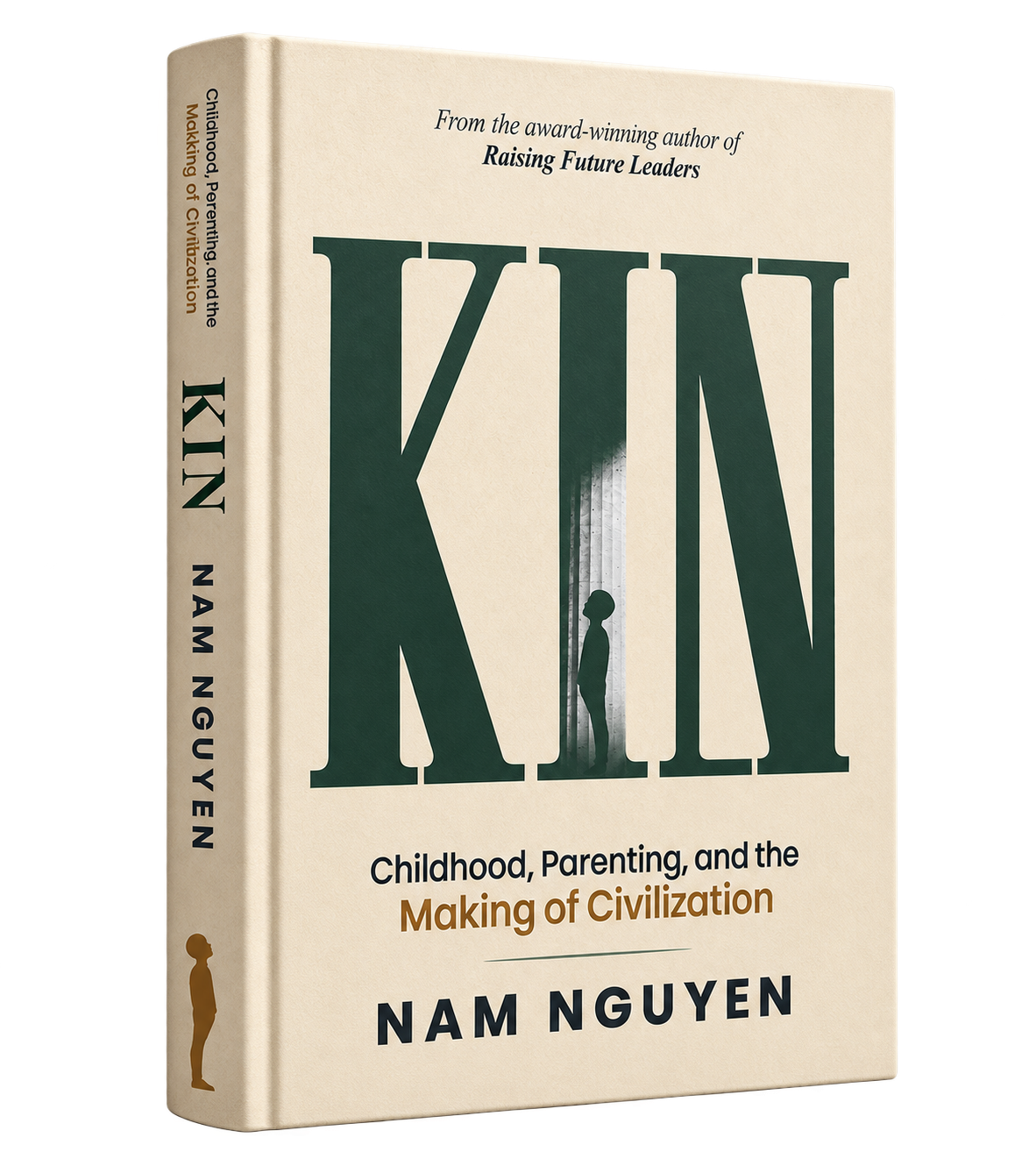
A NEW HISTORY OF CIVILIZATION
History is usually told through wars, empires, inventions, and institutions. KIN begins somewhere else: with the children every civilization had to raise before it could have a future.
From humanity’s first cooperative families to children growing up with artificial intelligence, KIN reveals how the raising
of each generation has shaped the societies that followed.
Available September 1, 2026
Childhood has always been part of history.
Every society depends on a wager it rarely names: that it can raise children capable of carrying forward a world the adults themselves will not live long enough to see.
Yet we speak about politics, technology, economies, war, and institutions as though childhood exists outside history.
KIN challenges that assumption.
Across human history, societies have raised children for the worlds they needed: heirs, workers, believers, citizens, consumers, digital natives—and perhaps, soon, children raised alongside artificial intelligence.
KIN follows that thread from humanity's earliest cooperative families to the possible future of childhood in an age of algorithms, demographic decline, climate anxiety, and synthetic biology.
What kind of people are we raising—
and what kind of world is raising them?
What KIN explores
THE FIRST FAMILIES
Why the unusual helplessness of human children helped make cooperation essential to our survival.
CHILDHOOD AS AN INSTITUTION
How religion, states, schools, markets and families have each shaped the kind of adults societies needed.
THE MODERN CHILD
How children became increasingly protected, educated, psychologically understood—and expensive to raise.
THE CHILDREN OF WHAT COMES NEXT
What artificial intelligence, demographic change and emerging technologies may mean for childhood itself.
For readers drawn to big questions
KIN is for readers interested in how human beings are made—not biologically, but socially. It brings together history, psychology, anthropology, education and technology to examine how childhood has quietly shaped the societies adults later inherit.
If you read history to better understand the future, KIN was written for you.
Book Details
Title: KIN: Childhood, Parenting, and the Making of Civilization
Author: Nam Nguyen
Publisher: Octomind Publishing
Publication Year: 2026
Formats: Paperback, Hardcover, E-book
Paperback ISBN: 978-1-0697546-3-9
Hardcover ISBN: 978-1-0697546-5-3
E-book ISBN: 978-1-0697546-4-6